
Shape
On Ben Lerner's two hearts

On a train journey back home after a book event, I did one of my favourite things: listened to a podcast of Ben Lerner reading one of his stories aloud. I have long loved the combination of his Midwestern accent and his swelling sentences. This story, ‘The Readers’, was just published in The New Yorker. His narrator, a writer, has just started attending therapy, and asks the therapist to refrain from reading any of his novels (the poems he does not mind so much). She agrees - though Lerner discovers she herself is a writer and reads one of her works of creative nonfiction. Lerner renders the swirl of his narrator’s thoughts in hilarious detail, as the character examines the motivation for his ban, and his therapist’s response to it. There is a sharp divergence when the narrator’s heart problem enters the story - the therapy room no longer a vehicle for his neurotic overthinking, but a space of real crisis. In the aftermath of a serious operation, as he convaleses at home, the narrator writes an essay about the procedure, which is published in a magazine. He starts carrying around a copy of it, the cover of which features a picture of a heart. He decides he wants to give his therapist this magazine, in which is contained this essay, the most truthful account of what has just happened to him, but she demurs. The remainder of the story is about his reeling from her refusal, a refusal (as he sees it) of his healing, of his perspective, of himself.
I thought the story was beautiful, but at the moment the diagnosis entered, I had a shock: only last week had I read Lerner’s essay ‘Cardiography’ in the New York Review of Books in which he details an operation to replace a part of his aorta. The cover of that edition of the magazine, November 6th 2025, has an illustration of a heart. Details in The New Yorker story have been changed (the narrator has two sons not two daughters, for example) but both are essentially him, Lerner, and details crossover: in both he thinks deeply about writing and its ethics, the potential of the ‘cardiac blues’ unnerves him, and he riffs on the many meanings of and associations with the heart.
Of course, this play with reality and fiction is what Lerner is known for, as one of the Known Writers of Autofiction, which lots of people have opinions on. But this wasn’t on my mind as the story transformed across these pieces of writing. Instead, I was fascinated by the writer’s choice, for this event to live twice, in two forms. An essay, and a story. I wondered if Lerner would want us to read one, then the other; I wondered if I had read it the right way round.
I thought also about the powerful frame of the essay, and of the pull I often feel to write in that form, even when I am startled by the results. In those moments, I want to see words pile up, gain solidity. An essay is a kind of record for thoughts which might otherwise have no shape, or barely surface. It’s a way of holding things in place, before they submerge once more. It also, as Lerner writes, allows for experimentation: the writing of ‘Cardiography’ is ‘a test of how changes in my pulse pressure waves have altered my sentence rhythms.’ He looks for himself in the construction of his words and wonders if he’ll find himself a stranger.
Lerner’s preoccupied with familiar sentence rhythm, but I’m frequently preoccupied by the rhythm of paragraph, by their possible association. I order and reorder them, experimenting with where I can start and stop, and where I can let ideas rest. The easiest line to write is the last; the hardest one the beginning. What comes in between is sometimes impossibly fluid; an essay reveals how hard it is to find the true ‘beginning’ of anything.
My focus on arrangement and organisation seems, at some moments, almost painfully revealing about my lack of ability to adequately control the sequence and events of my own life. I was reminded of this, too, in Lerner’s two works. The ‘I’ that writes an essay has a different relationship to the material of life than the ‘I’ of a story. The story of ‘The Readers’ becomes about the boundary between creation and self, and an imperative to guard that line; ‘Cardiography’ records the language of an event (interested as it is in the variety and power of cliche) with an almost overwhelming knowledge about the banality of total body transformation that many of us will endure.
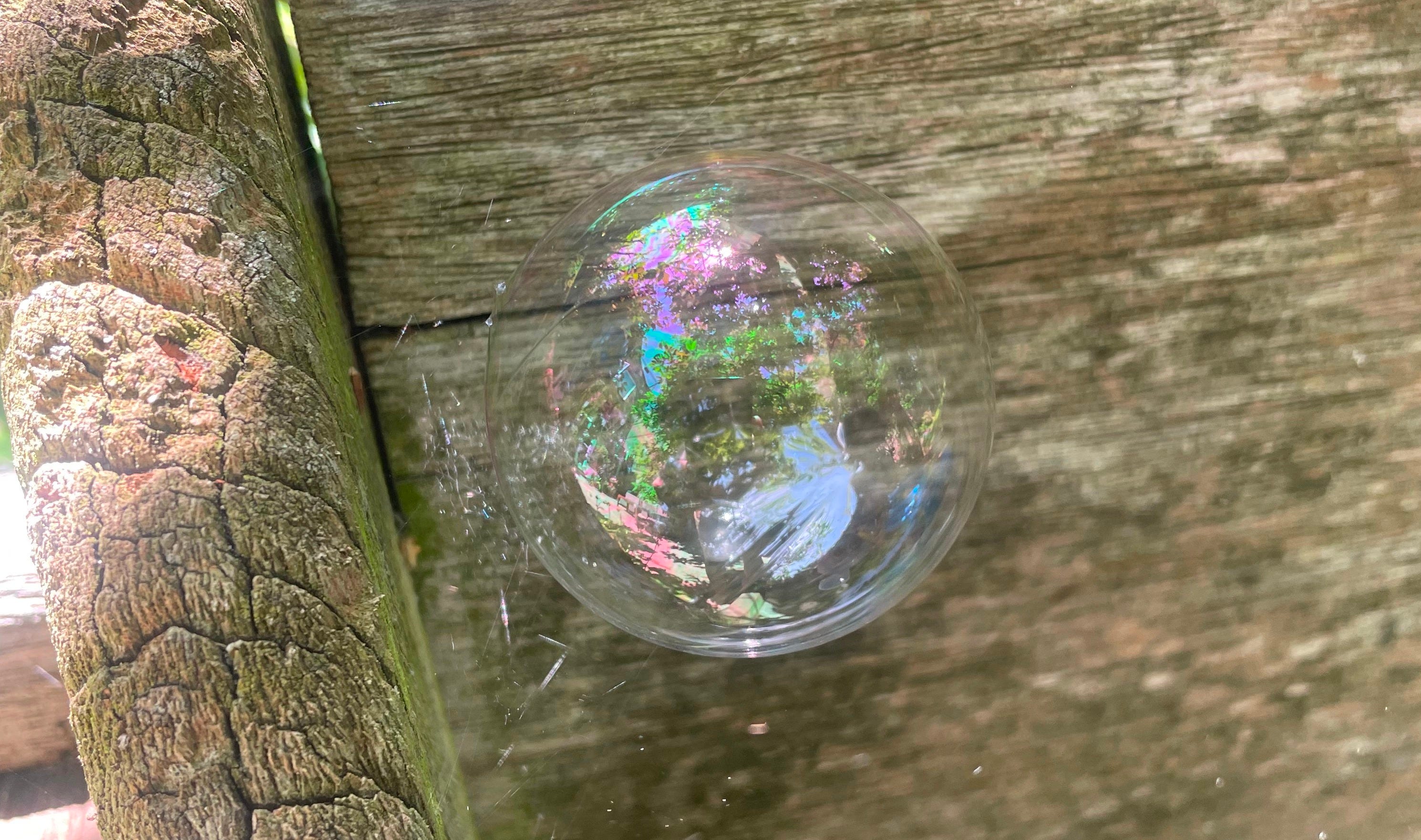
Though I loved both pieces, reading them together, I was struck by the importance of frame and the transformation of structure. It made me think about an afternoon recently where my son and I spent some time blowing bubbles in my parents’ garden, only to notice one caught in a spiderweb. We were both amazed at how trapped it looked, how held - until it suddenly popped. We tried a few times to catch other bubbles in the web, but they were never the same size, or in quite the same place. This to me feels like the essay: a bubble resting on a spiderweb.
Thank you for this, Katie. For sending me the way of those two brilliant pieces of Lerner writing, but also for your fascinating reflections on them. To read about other people's reading is such a particular pleasure!